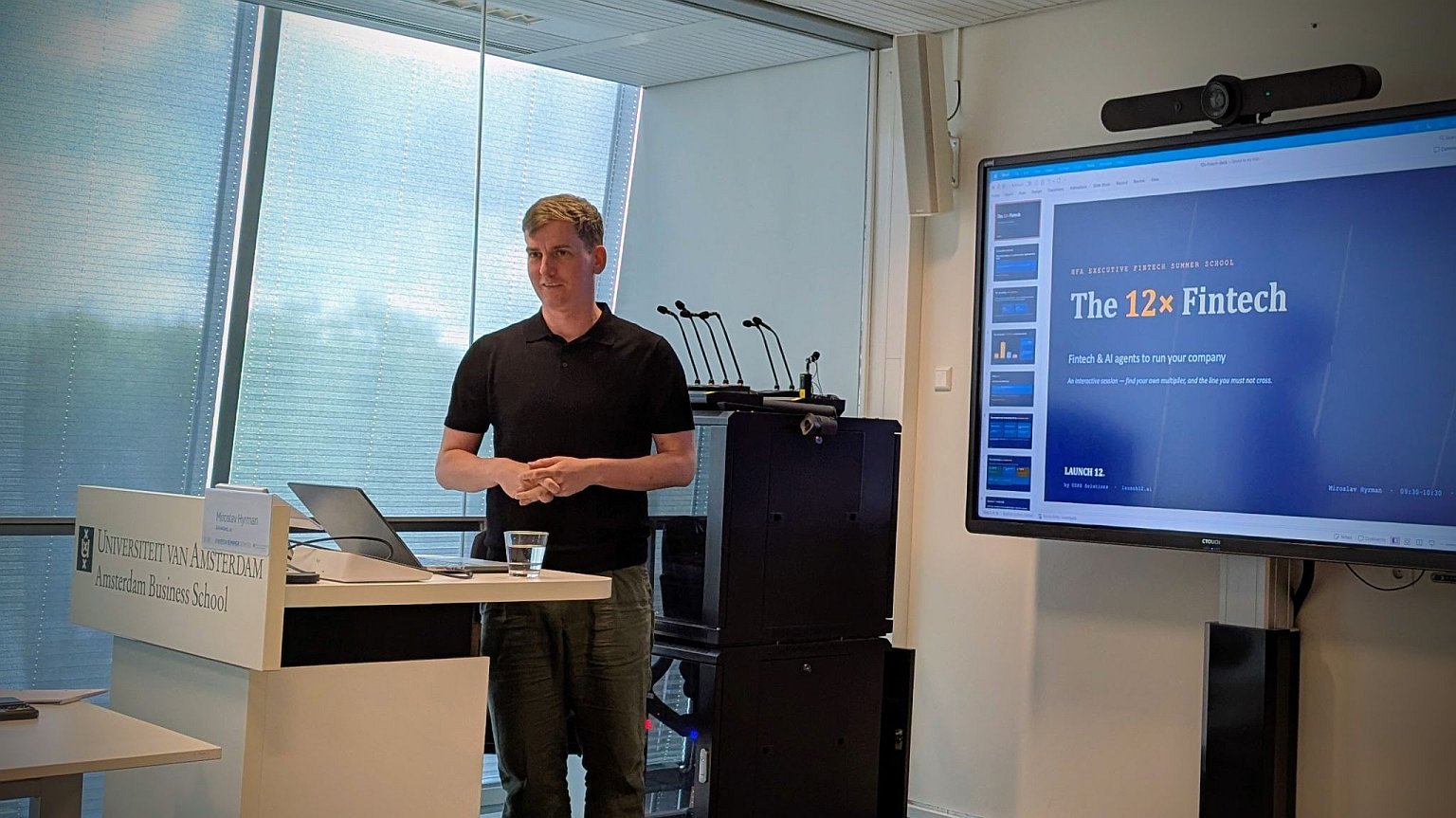
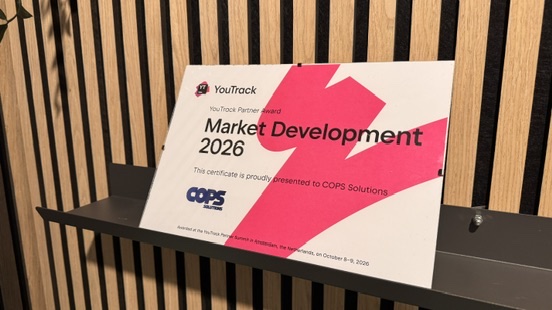
COPS Solutions took part in the HFA Executive Fintech Summer School (2–3 July 2026), the two-day executive intensive run by Holland Fintech Association together with AI4Fintech and the University of Amsterdam’s Amsterdam Business School. Under the banner of our venture studio LAUNCH 12, Miroslav Hyrman led The 12× Fintech — a 60-minute working session on running a company by directing AI agents, built for founders and for leaders inside regulated institutions alike.
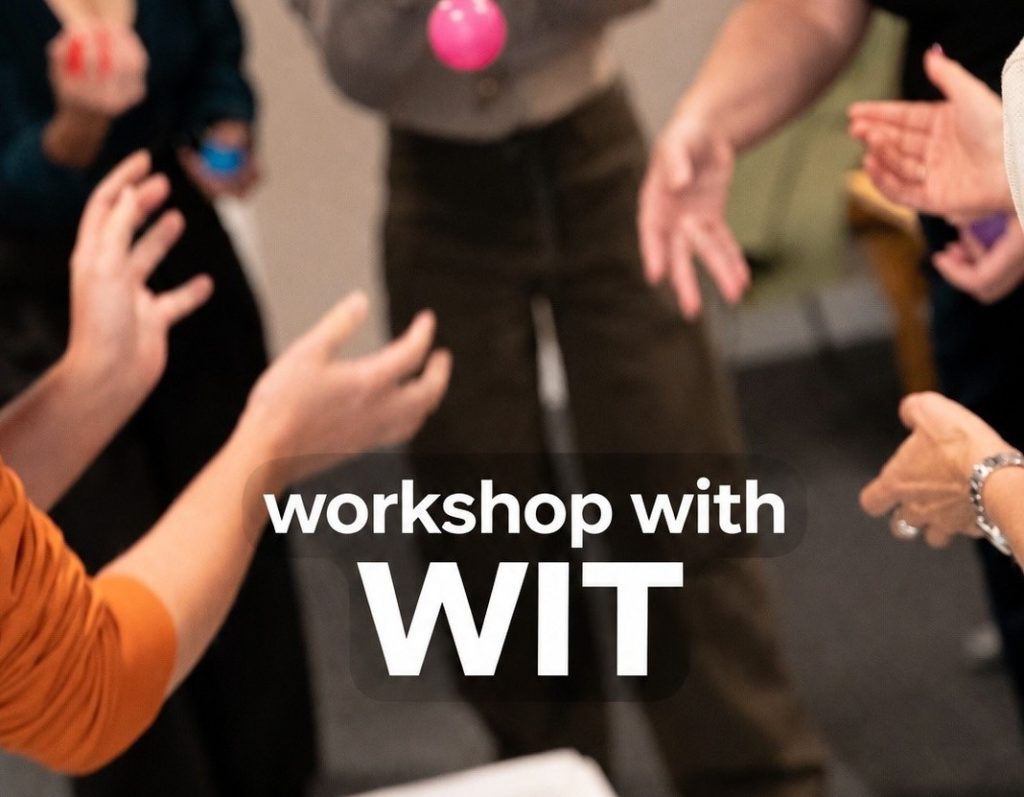
It was designed as a working session, not a talk. Instead of watching slides, every participant took their own week apart — sorting the tasks that actually cross their desk into what an agent does end-to-end, what it drafts for a human to approve, and what stays human only.
“12×” is a ceiling, not a promise
The session opened by clearing up the number in its title. “12×” isn’t a claim that everything gets twelve times faster. It’s the top of what’s possible once the work is redesigned around agents.
Two figures are easy to confuse, and separating them is the whole point. The eye-catching 20–50× gains happen at the level of individual tasks — the best-fit work an agent transforms, like drafting, assembly or extraction — and that is only a small slice of any job. Most work lands at a far more modest 2–3×, some is flat, and a stubborn tail runs backwards: the “0.7× trap,” where the agent hands back something you then have to check and redo.
The 12× is a different measure altogether. It sits at the level of a person — one operator, directing agents, reproducing what used to take a small team. It comes from blending that whole distribution together, not from stacking the peaks on top of each other. Bolt agents onto an unchanged process and the drag pulls the blend down toward 2–3×; redesign the work around them, and the same tasks climb toward 12×. That is also why the fastest win in the room wasn’t adding AI — it was subtracting the negative-return workflows.
What people refused to hand over
The most revealing moment came when participants marked their “human only” tasks. The pattern was consistent and counterintuitive: almost nobody protected their hardest work. Agents are good at hard. What people held onto was the accountable work — the decision they’d answer for, the relationship they stand behind, the judgment call with their name on it.
That says as much about us as about the technology. Our instinct for what feels “uniquely human” tracks responsibility, trust and identity far more than difficulty — with a quiet ownership bias on top, since we tend to over-value the work we already hold. Naming that line on purpose, rather than defending everything out of habit, is what frees a team to automate the rest with confidence.
Agents or juniors?
A recurring question was blunter: is an agent setup really cheaper than using junior staff? On routine, high-volume work — gathering, screening, first drafts — agents win on speed and cost, running in parallel around the clock. But juniors aren’t only cheap capacity; they are the pipeline that produces tomorrow’s accountable seniors. Automate the entry-level rung away entirely, and you have to ask where your future decision-makers come from. The answer isn’t “replace juniors” — it’s redesign what they do, and move them up the value chain sooner.
Why this matters to COPS Solutions
For us, this isn’t a side act — it’s the thesis behind how we build. COPS Solutions is a venture builder, and LAUNCH 12 is our own proof of the idea: we took our venture-building practice and turned it into a product. AI is compressing the value of expertise — a decade of methodology increasingly lives behind a one-minute prompt — so LAUNCH 12 helps experts and operators productise theirs before that happens, going from practice to product, pitch to launch, in about twelve weeks. What makes that timeline real rather than aspirational is the delivery muscle behind it: decades of enterprise and critical-infrastructure work, and €20M invested across 20+ ventures. The method in this session isn’t a framework we teach — it’s how we run those builds, having rebuilt our own firm around AI before doing it for anyone else.
That is the real takeaway. The operators who win this decade will be the ones who can tell their 20–50× work from their 0.7×, and who know exactly which calls belong on a human’s desk. Helping them find that line — and build the product on the other side of it — is what LAUNCH 12 is for.
We’re grateful to Holland Fintech Association and the summer school’s partners for the invitation, and to a genuinely engaged room that turned a talk into a working session.